Artificial general intelligence vs applied industrial AI
Artificial general intelligence describes a broad research ambition. An industrial AI application has a narrower task: recognize an assembly error, interpret a sensor pattern or help a machine respond to its surroundings. The useful specification is the decision, the acceptable error and the time available to act. Alvexis scopes physical AI around those concrete requirements.
Machine learning and deep learning are methods within that design. Supervised machine learning needs representative labelled examples; unsupervised machine learning can help explore patterns without predefined labels. Neither removes the need to test operating conditions, uncertain inputs and a safe response when confidence is low.
TinyML and artificial intelligence at the edge
TinyML can be appropriate when a small model fits the memory and timing budget of a microcontroller. Larger vision workloads may need an NPU or a different compute platform. Start with the complete sensor-to-decision path: acquisition, preprocessing, inference and the output interface. Select the processor after measuring that workload.
Technical references
What is Physical AI?
Physical AI describes AI systems that perceive and interact with the physical world. A camera supplies observations, software interprets them, and the result informs a person or an action in a machine. NVIDIA's Physical AI overview describes this relationship between perception, reasoning and real-world action. An industrial application does not need to resemble a humanoid robot: a fixed inspection station with a controlled reject mechanism can have a much narrower, valuable purpose.
Physical AI, edge AI and robotics AI describe different aspects of a system. Physical AI describes its relationship to the environment. Edge AI describes where computation happens, close to the source of data. Robotics AI applies intelligence to a robot's perception, decisions or movement. They often overlap, but a sensor gateway can be useful without AI, and a conventional control loop can be the right answer to a predictable task.
For a buyer, the useful question is specific: which operational decision is difficult today, what evidence would improve it, and how will improvement be measured? Start there before selecting a processor, camera or model.
Physical AI applications across industries
The following twelve application areas cover the sectors presented on the Alvexis site and extend the discussion to medicine, transport, retail and environmental systems. These are development opportunities and example pilot scopes, not claims of completed customer deployments. Select a sector to jump to its engineering questions.
Inspect the process while it is happening.
A camera station could check assembly, surface appearance or part presence and pass a decision to a PLC. Motor measurements could support maintenance triage. The product includes lighting, fixtures, timing, interfaces and an operator workflow as well as a model.
Define the pilot: Which defect types count? How many false rejects can the line tolerate? Measure missed defects and false rejects by product variant, together with cycle time.
Explore factory applications →Give movement useful context.
Ground robots and handling systems can combine cameras, range sensors and motion feedback to navigate, locate a load or inspect an item. Intelligence must connect to the robot's control architecture and recovery behaviour.
Define the pilot: Bound the operating area, payloads and allowed tasks. Measure completed missions, operator interventions and recovery time under representative traffic.
Read the Robotics AI guide →Connect field observations to a growing decision.
Soil and climate nodes, local image processing and irrigation interfaces could support a defined crop workflow. Installation, changing sunlight, dirt, power availability and communications shape the electronics as much as inference does.
Define the pilot: Choose one crop, environment and decision. Compare observations against an agreed reference over relevant conditions, including sensor fouling and network outages.
Explore crop and greenhouse applications →Observe animals and their surroundings.
Connected cameras and environmental sensors could help staff review activity, barn conditions and changes that deserve attention. Occlusion, animal movement, lighting and sensor placement determine what can be observed reliably.
Define the pilot: Select an observable behaviour and a staff response. Track missed observations and nuisance alerts across different barn conditions. Veterinary conclusions require their own evidence and professional assessment.
Explore livestock applications →Turn equipment measurements into maintenance evidence.
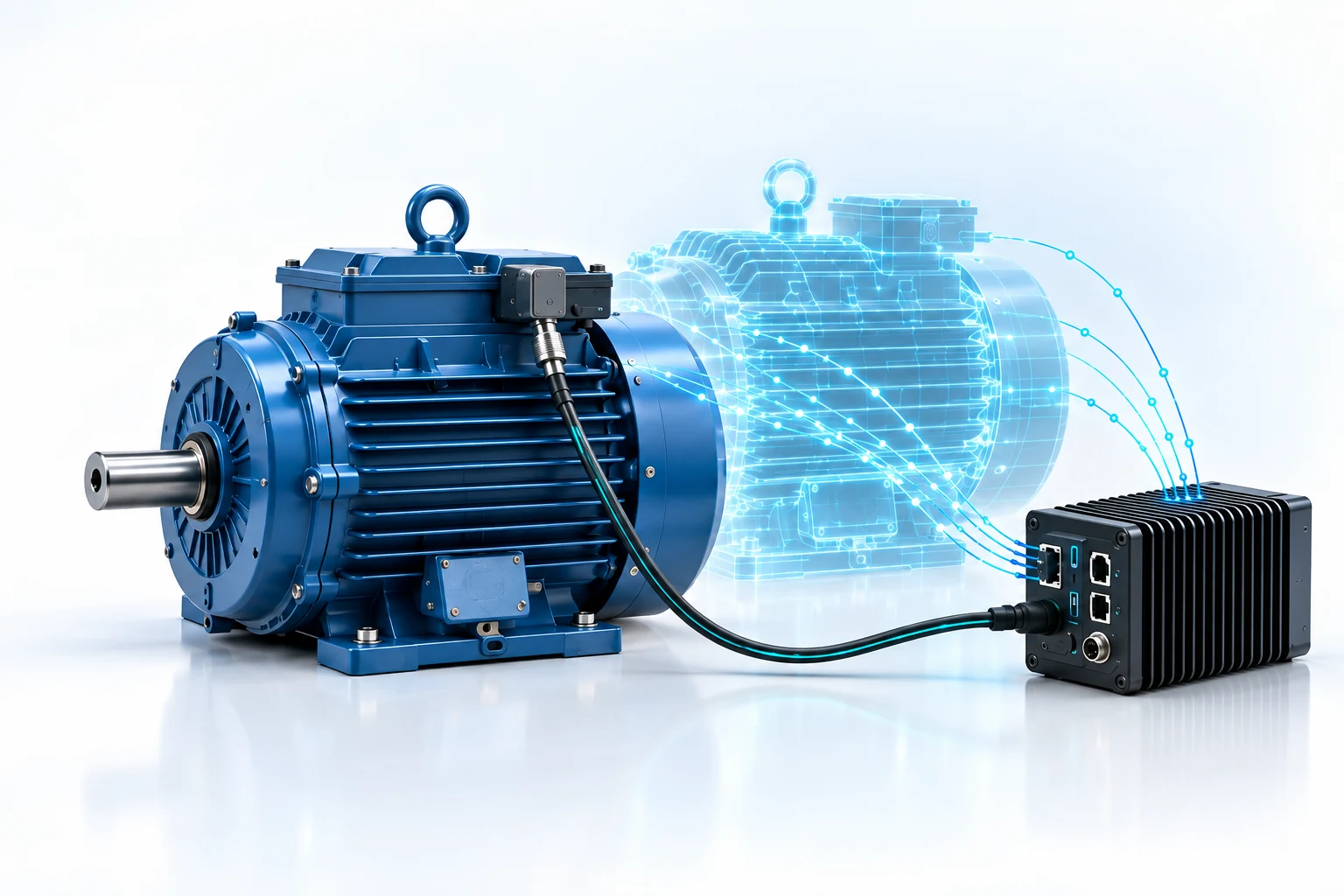
Edge devices could collect vibration, temperature and operating-state information from motors, pumps or renewable-energy equipment. A useful result connects a change in measurements to a reviewable event and an existing maintenance process.
Define the pilot: Establish a baseline for each operating regime. Check alert repeatability, data availability and performance during start-up, load changes and power disturbances.
Explore energy applications →Make local infrastructure easier to understand.
Environmental nodes, equipment monitoring and aggregate traffic-flow analytics could support city services. A local processing design can produce counts or events instead of transmitting a continuous raw stream, where the application permits.
Define the pilot: Specify the decision owner, observation area and retained information. Evaluate accuracy across weather and lighting, along with sensor uptime and maintenance access.
Explore Smart Cities applications →Build around difficult installation conditions.
Machine-mounted sensing and rugged gateways could provide equipment condition data, local event records and worksite telemetry. Dust, vibration, connector retention and transient power need to be part of the product requirements.
Define the pilot: Select a machine and a measurable condition. Verify sensor attachment, power recovery and data continuity in the intended installation before evaluating a fleet.
Explore worksite applications →Keep sensing and communications dependable in the field.
Potential applications include vehicle condition monitoring, maintenance diagnostics, synchronized sensor recording and equipment telemetry. Computing, enclosure and interfaces must be selected against the environmental and integration requirements of the program.
Define the pilot: Agree on temperature, power and communications conditions. Measure timestamp alignment, restart behaviour and the evidence retained when connectivity is unavailable.
Explore field-system engineering →Connect physical sensing to a defined care or laboratory workflow.
Application areas include laboratory handling, equipment monitoring, rehabilitation measurement and medical sensing prototypes. Clinical decision support and patient-contact robotics require a different evidence program from a hospital delivery cart.
Define the pilot: State the intended user, patient population if relevant, input, output and who acts on it. Work with clinical and regulatory specialists before assigning diagnostic or treatment claims.
Read the healthcare engineering guide →Observe vehicle and fleet conditions locally.
Rail, road and marine equipment can create demanding sensing and logging problems. Candidate projects include subsystem condition monitoring, loading observation and onboard data gateways. Connectivity gaps and electrical interfaces influence the architecture.
Define the pilot: Specify the platform, installation position and operator workflow. Measure useful-event capture, synchronization and recovery; validate any control function within the vehicle program's own assurance process.
Explore interface and gateway options →Help staff respond to the physical state of a site.
Shelf observation, cold-storage equipment monitoring and service-robot integration are possible starting points. The result should be a clear action for a staff member, rather than another feed that someone has to watch.
Define the pilot: Choose an event and an operational owner. Measure useful alerts, false alerts and response time. Use aggregate or non-identifying outputs where they meet the requirement.
Discuss a service-operations product →Connect distributed assets to an actionable view.
Building services, water networks and environmental stations could combine local sensing, equipment-state inference and communications. Calibration access, power budgets and maintainability often decide whether a pilot can become a long-lived installation.
Define the pilot: Specify measurement quality, operating range and servicing intervals. Test drift, missing data and communications recovery as well as the intended analytics.
Explore field communications →The common architecture behind different sectors
The application changes, but the product still needs an acquisition path, computation, physical interfaces and a defined response to faults. Avoid treating the AI model as the complete system. A late or misaligned observation can make a correct prediction unusable at the machine interface.
| Layer | Decision to make | Evidence to collect |
|---|---|---|
| Sensing | Field of view, bandwidth, mounting and calibration | Representative data, signal quality and blind spots |
| Compute | CPU tasks, supported AI acceleration, memory and thermal budget | Sustained workload measurements on the target hardware |
| Integration | PLC, machine bus, network or operator interface | Timing, message loss, invalid-input and restart behaviour |
| Mechanical design | Enclosure, cooling, service access and connectors | Installation and environmental verification |
| Operation | Who can act, override, update and recover | Event records, version traceability and acceptance results |
A ready platform can make the first experiment easier. Custom electronics become useful when interfaces, dimensions, power, cost or environmental requirements justify a dedicated design. Our SoM versus SBC guide explains that decision; the carrier-board guide describes the engineering scope that follows.
Where digital twins and simulation fit
A digital representation is useful when it answers a testable question: can a robot reach a location, does a sensor cover the required area, or how does a process respond to a changed input? Keep the model's assumptions visible. A polished visualization and a predictive model are different deliverables.
Simulation can make experiments repeatable and help expose failure cases before a physical pilot. It cannot establish performance under every real material, lighting condition or mechanical tolerance. Compare model outputs against measurements, record the mismatch and determine where the model is trustworthy. NVIDIA's sim-to-real learning example illustrates a workflow that moves from simulation to a physical robot; it is a reference workflow, not evidence for an Alvexis deployment.
Start with one decision and a measurable pilot
- Describe the operational problem. Identify the current workflow, cost of errors and person responsible for the output.
- Collect representative observations. Include ordinary operation, variation and difficult cases; agree on what counts as ground truth.
- Define the response. Decide whether the system records, alerts, recommends or controls. Specify when it must defer to a person.
- Test the whole path. Measure useful-task performance, output age, sustained resource use and recovery from faults.
- Set a release boundary. Agree on acceptance evidence, deployment conditions, maintenance and update responsibilities.
Start in observation mode when practical: compare the proposed output against the existing workflow before allowing it to change that workflow. A promising prototype should earn the next level of responsibility through evidence.
How Alvexis can help build the physical product
Alvexis develops custom electronics, embedded software and mechanical designs around application requirements. A project can start with ForgeEdge-Core, explore ForgeEdge for integrated edge computing or use a dedicated carrier and enclosure when the installation demands it. Platform selection follows the workload and integration plan.
Reusable engineering platforms and parallel development can shorten the route to a working prototype. The actual schedule depends on sensor access, application data, board revisions, mechanical tooling and acceptance requirements. Define those dependencies at the start instead of promising one delivery time for every sector.
From Industrial IoT data to a useful digital twin
Industrial IoT connects observations from equipment; a digital twin relates those observations to a model of a physical asset or process. Physical AI can add perception and decisions at the machine. These roles overlap in a project, but collecting telemetry does not automatically create a predictive model or a validated control system.
For a production machine, combine timestamps, operating state and maintenance history before evaluating an AI model. A thermal imaging stream, vibration features or computer vision result should answer a specific operational question. Define how the model is updated, how stale data is shown and how an operator verifies the resulting recommendation. A practical pilot starts with one asset and one measurable decision.
Scope a machine monitoring pilot
Technical references
- NVIDIA: Physical AI concepts
- NVIDIA: a sim-to-real robot learning workflow
- FDA, Health Canada and MHRA: transparency for ML-enabled medical devices
Sector examples are engineering possibilities. Performance, suitability and any applicable approvals must be established for the particular product and use.
Describe the problem. Build the right system.
Tell us the sector, task, environment, sensors and result you need. We can discuss the electronics, software, enclosure and first validation step.
Discuss Your Physical AI ProjectContinue with Robotics AI →